07. Microscale Laboratory
2026 topic: Human Impact on the Aqueous Environment
Coordinator: Dr. Bhavani Balasubramanian
The maximum number of students per team for Microscale Event 7 is three.
Important: All documents and files for your experiment must be submitted by April 17th, 2026!
Relevance to the theme of the NJCO 2026 event:
Background:
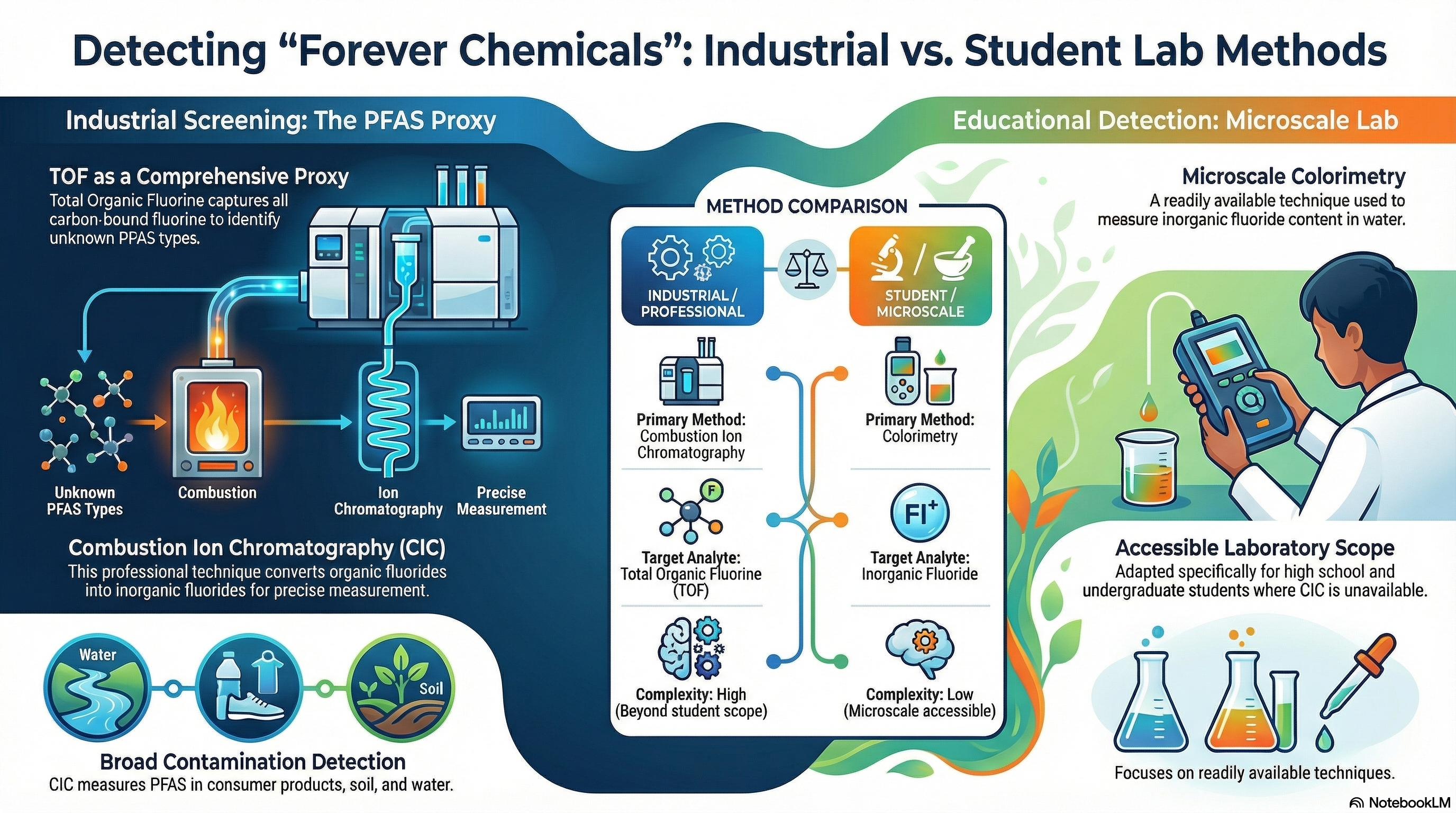
Total Organic Fluorine (TOF) serves as a comprehensive screening proxy for per- and polyfluoroalkyl substances (PFAS), capturing all fluorine bound to carbon, which defines PFAS. Techniques such as Combustion Ion Chromatography (CIC), which converts total organic fluorides to inorganic fluorides, can be used to measure PFAS contamination in consumer products, soil, and water, even when specific PFAS types are unknown. However, these techniques are beyond the scope of undergraduate and high school laboratory experiments. The concentration of fluoride in water can also be measured using other readily available techniques, such as colorimetry. In this experiment, you will measure the total inorganic fluoride content of a water sample using available microscale techniques. In your pre-lab report, you should discuss the merits and limitations of these microscale techniques for fluoride detection and compare them to the traditional methods for PFAS detection.
OBJECTIVE
Determine the total inorganic fluoride content of a water sample using available microscale techniques.
Materials and Methods Brought by Team to the Competition
Bring whatever you need to experiment with, but you must use microscale techniques. Make sure you have enough deionized water.
Burets are disallowed because microscale procedures do not use them.
Prior to starting, each team must provide the judges with a typed step-by-step description of the methods they intend to use to address the objective of this experiment.
INSTRUCTOR NOTES ON SPECIAL SAFETY CONSIDERATIONS
At all times, the instructor or coach should be in charge of the laboratory.
Review all procedures for safety concerns.
Teams won't be able to conduct their experiments unless the judges approve of their procedure in accordance with safety guidelines.
The team's evaluation procedure prior to the event must address the safety protocol.
Teams must practice procedures prior to the event. Judges reserve the right to dismiss unprepared teams on the day of the event.
Prior to the event:
The students should review the 12 principles of “Green Chemistry” developed by Paul Anastas and John Warner and illustrate how their procedure adheres to these principles.
A step-by-step description of the methods and safety protocol must be submitted by the due date!
You must practice your procedure. Judges may disqualify entrants who are not confident about their procedure and, as a result, pose a safety risk. Review, be familiar with, and be prepared to follow all safety guidelines associated with your chosen method.
Research appropriate small-scale techniques or microscale techniques. Lab manuals are available from various scientific suppliers, including Flinn Scientific, Inc. Furthermore, publications such as the Journal of Chemical Education may serve as sources for specific microscale techniques.
On the Day of the Event:
Follow your team's laboratory procedure to collect and record data for at least three trials.
Complete appropriate calculations first to determine the total inorganic fluoride content of a water sample
Clean up and then submit your report, showing all calculations on the back of the report page.
Time Limit: 75 minutes
Judging Criteria
Description of methods, including “green” approach (30%)
Description of safety concerns addressed within the procedure, 15%
Presentation of Data and Calculations, 30%
Accuracy of the calculations: 25%
Time (tiebreaker)
Notes
Events 5, 6, and 7 require two teams from the same school to compete in the same time slot unless the NJCO Director approves. The requested times will be adjusted for this!
In the event of a tie, the team that completes this session in the shortest time will win the tie.
Teams must clean up and remove all materials they bring to this event and return them to their schools.
Team Identification
Each submission (research reports, website links, lab reports, etc.) must include the following 4 items:
- Name of school
- Team A or B designation, if applicable
- Names of students (printed legibly)
- Name of coach
ALL PARTICIPANTS MUST BRING (APPROVED) GOGGLES, GLOVES, AND APRON OR LAB COAT AND USE THEM AT ALL TIMES DURING THE COMPETITION. STUDENTS MUST ADHERE TO BOTH GENERAL LAB SAFETY PROTOCOLS AND THOSE SPECIFIC TO THEIR CHOSEN PROCEDURE.